Researching with GitHub Copilot Agents: Investigating Code and Producing Cited Findings
Most developers think of AI agents as code generators: you hand them a task and they write the code or open a pull request. However, in complex real-world software engineering, writing code is often the easy part. The real bottleneck is researching - understanding an unfamiliar repository, tracing features across microservices, auditing dependencies and confirming assumptions before a single line is changed.
With Researching with Agents, GitHub Copilot expands from a code-writing assistant into an autonomous investigation partner.
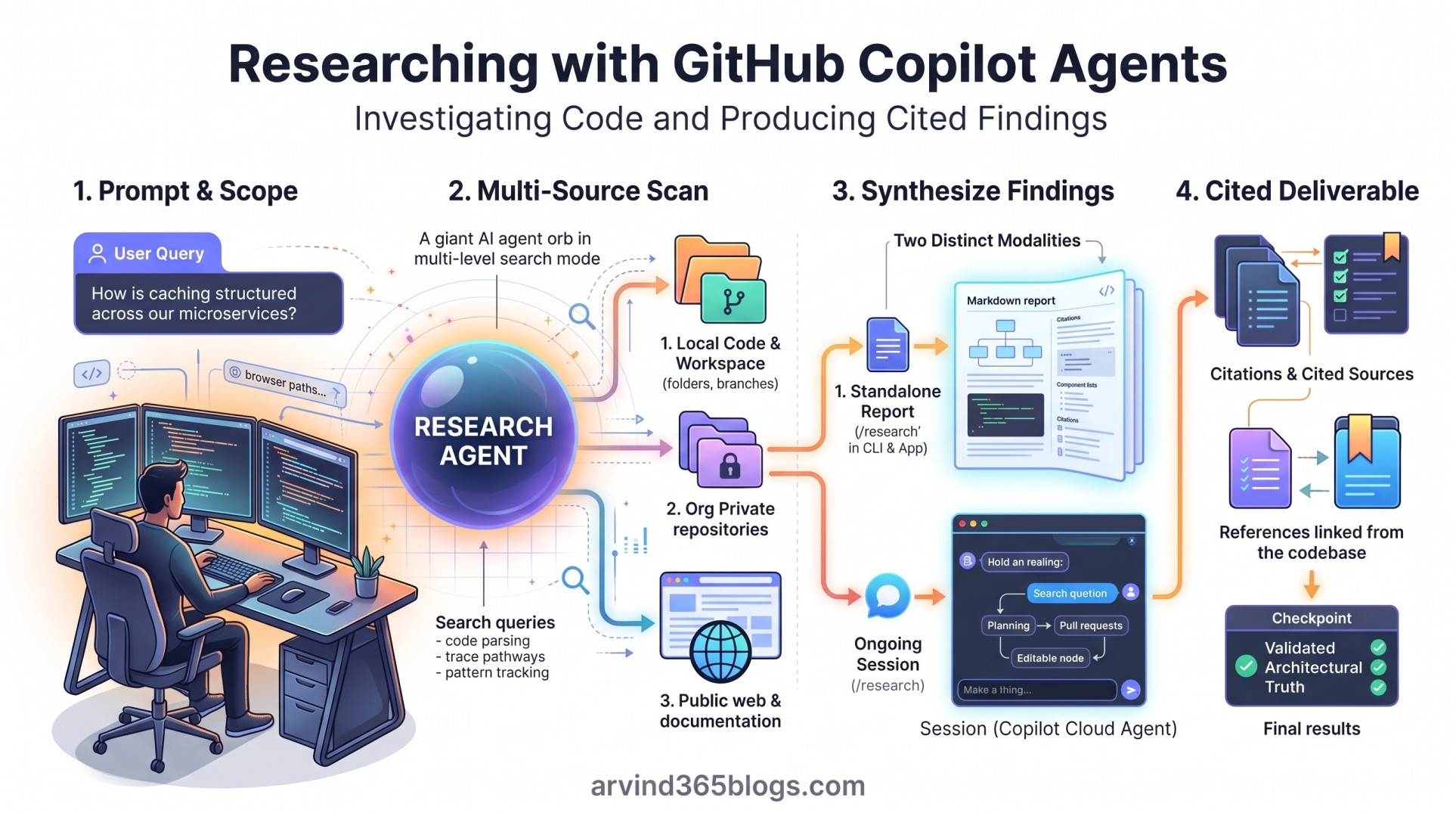
Instead of returning quick, conversational snippets, research agents are designed for deep inquiry. They gather evidence across local codebases, private enterprise repositories and public web sources to produce comprehensive, cited Markdown reports or seamlessly transition into planning and execution.
Two Distinct Research Modalities
Depending on where you work across the GitHub Copilot ecosystem, agent-assisted research operates through two distinct patterns:
• Standalone Cited Report (/research):
  Available in Copilot CLI & the Copilot App. Conducts a multi-source scan across local code, organization repositories and the web to produce a durable, cited Markdown file.

• In-Session Investigation (Copilot Cloud Agent):
  Available on GitHub.com and chat integrations. Performs deep codebase investigation inside an active session, allowing you to steer findings and transition directly into planning and code PRs.
This separation ensures that whether you need permanent documentation for an architecture review or quick, iterative discovery before code generation, the agent provides the appropriate deliverable.
1. Producing Durable, Cited Reports via /research
Available in the GitHub Copilot app and GitHub Copilot CLI, the /research slash command invokes a specialized research agent.
Unlike transient chat conversations that scroll away, /research generates a persistent Markdown report that can be hundreds of lines long. It investigates:
- Local & Organizational Code: Analyzes your active workspace and related repositories across your organization.
- Cross-Repository Fetching: Pulls relevant files from both public and accessible private repositories.
- Web Intelligence: Searches public documentation, specs and external technical resources.
- Full Citations: Generates code references, component breakdowns and architecture diagrams backed by cited sources.
Because the report saves as a standard Markdown file, it becomes a durable team artifact that can be stored in the repository, shared in an issue or referenced during design reviews.
2. In-Session Investigation with Copilot Cloud Agent
When working on GitHub.com (via the Agents tab, panel or chat) or through integrations like Microsoft Teams and Slack, research takes a fluid, iterative shape.
Here, you can ask Copilot cloud agent to explore an unfamiliar codebase or evaluate an issue before committing to changes. The agent explains architecture, maps out components and validates assumptions inside the ongoing session.
Research & Investigate ➔ Steer Findings ➔ Formulate Action Plan ➔ Implement Code & PRYou can steer the investigation with follow-up prompts: "Explain how payment retry tokens are cached, check if Redis is clustered and create an implementation plan to support idempotency." Once satisfied with the findings, you instruct the agent to move directly into code changes.
When to Use Agent-Assisted Research
For narrow questions with localized scope, a quick chat prompt remains the fastest choice. Research agents deliver maximum ROI when tackling broader questions:
Rapidly understand the architecture, data models and conventions of a legacy project or newly acquired repository without reading thousands of lines manually.
Trace how an authentication token, shared schema or workflow traverses across microservices, frontends and shared libraries.
Compare technologies or implementation patterns by combining internal repository code with public web standards and documentation.
Investigate edge cases, test coverage gaps and potential breaking changes before approving an autonomous coding agent to generate a pull request.
Prompting for High-Quality Research
Because research agents adapt their investigation depth to your question, how you frame your prompt directly shapes the final deliverable:
Instead of asking: "How does our caching work?"
Ask: "Produce a technical deep dive on our distributed caching layer, including component diagrams, fallback strategies and citations to relevant repos."
Mention relevant frameworks, repositories, time horizons or compliance requirements so the agent focuses its multi-source investigation efficiently.
Architectural & Leadership Perspective
From a software architecture and technology leadership standpoint, research agents shift the AI value proposition from mechanical coding to strategic clarity.
The engineering workflow evolves:
“Blind Coding & Guesswork” ➔ “Multi-Source Investigation & Cited Analysis” ➔ “Confident Implementation”
When senior engineers can commission thorough, cited technical investigations in minutes, architectural decisions become more defensible, onboarding accelerates and teams reduce costly refactoring cycles caused by misunderstood requirements.
Delegating research before delegation of implementation ensures that autonomous AI agents build on validated architectural truth rather than unverified assumptions.
Final Thoughts
Researching with GitHub Copilot agents brings discipline and deep context to AI-assisted engineering. Whether you need a comprehensive Markdown artifact via /research or an interactive codebase evaluation with Copilot cloud agent, research agents ensure you build with clarity.
The winning formula for modern AI delivery:
Investigate thoroughly, verify evidence with citations, establish a clear plan and then let AI agents build the changes.