February 19, 2026 | ISV Product Development | 15 min read
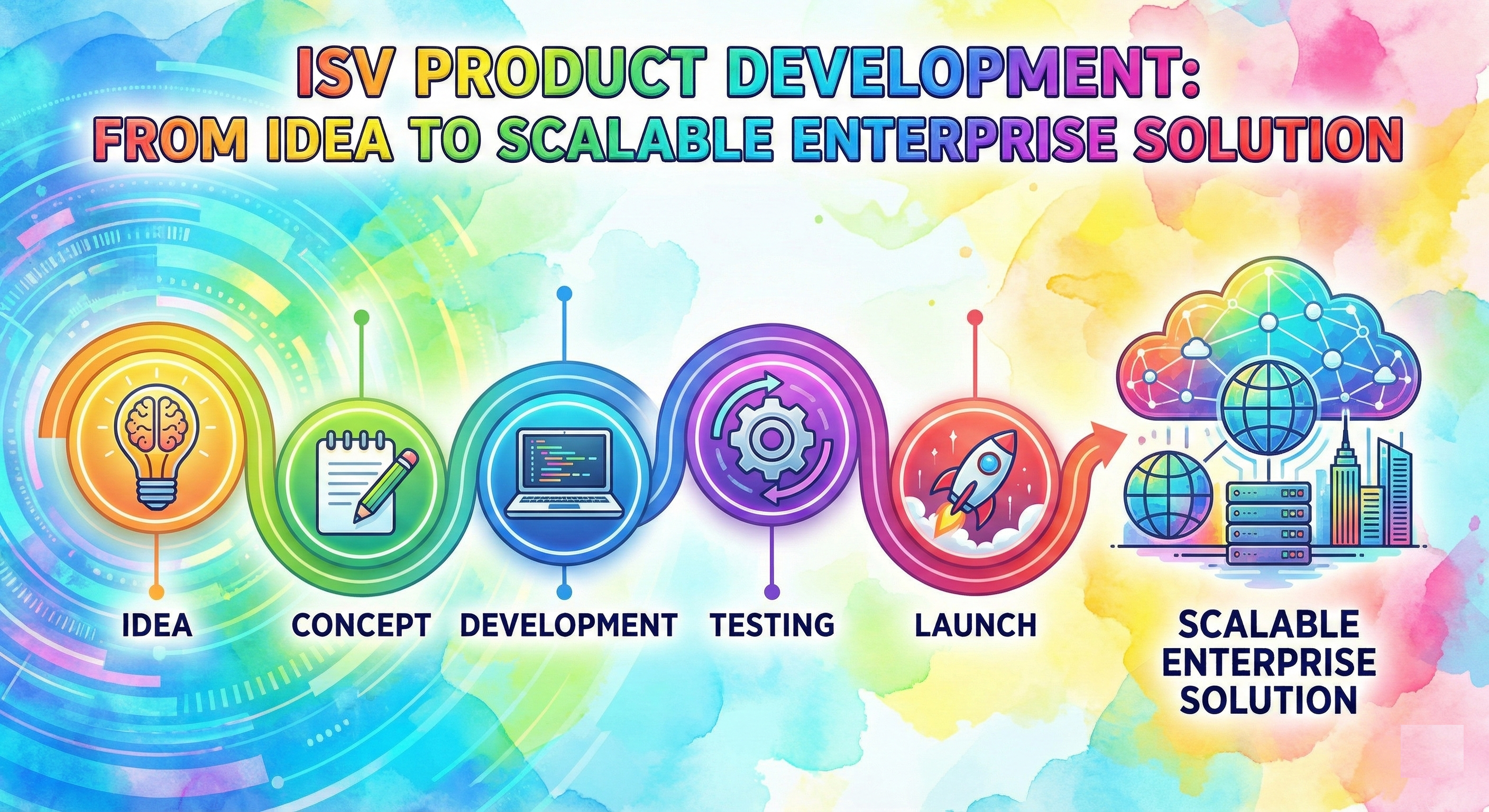
ISV Product Development: From Idea to Scalable Enterprise Solution
As a Senior Technical Developer working in a product team, I’ve realized that building an ISV product is very different from delivering a one-time customer project. In product development, every line of code must scale beyond a single implementation - it must support multiple customers, multiple environments and future upgrades that we haven’t even imagined yet. Over time, I’ve learned that success in ISV development isn’t just about solving today’s requirement; it’s about designing with extensibility, maintainability and long-term vision in mind.
Independent Software Vendors (ISVs) play a critical role in extending platforms like Microsoft Dynamics 365 and Microsoft Power Platform with industry-focused solutions. But building an ISV product is very different from delivering a customer-specific implementation.
It requires vision, scalability, governance and long-term architecture thinking.
In this blog, we’ll explore how to approach ISV product development strategically and technically.
What Makes ISV Product Development Different?
Unlike project-based implementations:
- You build once, but deploy to many customers. It still reminds me of my old Java days 😊 - "Write Once, Run Anywhere."
- Architecture must support multi-environment deployments.
- ALM and versioning become critical.
- Backward compatibility must be maintained.
- Feature toggling and modularization are essential.
In ecosystems like Microsoft Dynamics 365 and Microsoft Power Platform, the product must integrate seamlessly with the platform’s security, data model and extensibility framework.
Key Phases of ISV Product Development
1. Product Vision & Feature Strategy
- Identify reusable business capabilities
- Define product boundaries
- Separate core product from customer customizations
- Create feature roadmap (Wave-based planning can work well)
2. Modular Architecture
A scalable ISV product should:
- Separate features into independent solutions
- Use feature flags to enable/disable modules
- Avoid hard dependencies between modules
- Support layered solution architecture
Example:
- Core Solution
- Feature A Solution
- Feature B Solution
- Integration Solution
This helps by:
- Making the system easier to maintain
- Making upgrades smoother and safer
- Making deployments more flexible
3. Data Model Design
Good ISV products:
- Avoid modifying standard tables unnecessarily
- Use custom tables with clean naming conventions
- Follow publisher prefix discipline
- Design extensible relationships
4. ALM & Versioning Strategy
Application Lifecycle Management is the backbone of ISV success.
Recommended practices:
- Use Managed Solutions for customers
- Follow a structured version numbering approach (like 2.3.1) so changes are easy to track.
- Use different deployment pipelines for development, testing and production environments.
- Automate builds using Azure DevOps or GitHub
Each release must:
- Support upgrade paths
- Avoid breaking schema changes❗
- Handle data migration carefully❗
5. Feature Toggle & Configuration Model
Enterprise-ready ISV products should:
- Allow feature activation per environment
- Allow feature activation per customer
- Store configuration in dedicated setup tables
- Avoid hardcoding logic
This helps by:
- Releasing features in a controlled way
- Enabling paid or premium features easily
- Keeping existing customers stable during updates (Backward compatibility)
6. Performance & Scalability
An ISV solution must handle:
- Large datasets
- Multiple security roles
- Complex hierarchical models
- High transaction volume
Best practices:
- Write efficient queries : for example use FetchXML properly and only retrieve the fields you really need.
- Avoid unnecessary synchronous plugins : Don’t block the user’s screen for heavy logic.
- Use lazy loading : Load data only when it’s actually required.
- Use async processing for heavy operations : Long-running tasks should run in the background.
- Leverage PCF controls for better UX and performance : Use Power Apps Component Framework (PCF) to build optimized, responsive UI components instead of overloading forms with scripts.
7. Security & Governance
Security should never be an afterthought.
- Give users access based on their role.
- Secure sensitive fields when needed.
- Keep configurations separate for each environment.
- Design the system to support auditing and tracking.
Common Mistakes in ISV Development
- Designing like a customer project
- Over-customizing standard entities
- Not following proper version control
- Hard-coded business rules
- Not separating features properly
- Not testing upgrades thoroughly
ISV Success Factors
- ✅Strong and well-planned architecture
- ✅Keep different parts of the system independent
- ✅Ensure upgrades don’t break existing customers
- ✅Automate deployments wherever possible
- ✅Maintain clear and updated documentation
- ✅Design a data model that can grow with the product
A successful ISV product is not just functional - it is upgrade-safe, scalable and strategically designed.
Conclusion
Over the years, I’ve realized that ISV product development demands a real mindset shift from simply implementing requirements to truly thinking like a product engineer. It’s no longer just about making something work for one customer; it’s about designing something that can scale, evolve and survive platform changes.
Today, before finalizing any design, one should ask:
Will this still work for 50 customers, five years from now, across multiple platform updates?
That single question changes how you design tables, write plugins, structure solutions and even name fields.
When built correctly, an ISV product becomes:
- A repeatable revenue engine
- A scalable platform for continuous innovation
- A long-term competitive advantage in the market
And that’s when you know you’re not just building features - you’re building a product.