October 1, 2026 | Artificial Intelligence | 6 min read
AI as a Digital Companion: From Tool to Thought Partner
Artificial Intelligence has quickly moved from something we experimented with to something we use in our everyday work.
As a Technical Product Owner, I have seen this change closely. Earlier, we mostly looked at AI as a tool that could help us complete a specific task-write code, summarize information, generate content or answer a question.
Today, I see AI evolving into something more useful: a digital companion.
Not someone who replaces us.😊
Not someone who makes every decision for us.
But a companion that helps us think, create, learn and work better.
AI is moving beyond simple automation
Traditional automation follows predefined rules:
If this happens, do that.
AI works differently. It can understand context, interpret information, identify patterns, generate ideas and interact with us using natural language.
This changes how we work.
Instead of opening multiple tools and manually moving information between them, we can increasingly describe what we want and let AI help us move from intent to action.
For example:
- A developer can ask AI to explain an unfamiliar piece of code.
- A product owner can use AI to summarize customer feedback.
- A project manager can ask AI to identify potential risks.
- A business user can explore data using natural language.
- A team can use AI to prepare meeting summaries and identify action items.
The value is not just automation.
The bigger opportunity is augmentation.
What do I mean by a Digital Companion?
I think of a digital companion as an AI assistant that stays close to our work and helps us throughout the day.
Imagine starting your morning and asking:
“What should I focus on today?”
The AI could look at your tasks, meetings, priorities, project status, pending decisions and recent updates and help you understand what deserves attention.
Later, you might ask:
“Why is this project delayed?”
Instead of simply giving you a piece of information, the AI could help connect the dots-schedule changes, dependencies, risks, resource constraints and previous decisions.
Then, while working on a feature:
“Give me three options to solve this problem and explain the trade-offs.”
The AI becomes part of the thinking process.
This is where I believe the idea of a digital companion becomes interesting.
AI can support different roles
A digital companion doesn't have to be the same for everyone.
For a developer, it can be a coding companion.
For a product owner, it can be a product companion.
For a project manager, it can be a project companion.
For a salesperson, it can be a sales companion.
For a business leader, it can be a decision-support companion.
The underlying AI may be similar, but the context changes its usefulness.
For me, the most valuable part is not simply asking AI:
“What is the answer?”
It is asking:
“What should I consider before making this decision?”
That is a very different relationship.
AI as a Product Companion
As a Technical Product Owner, I see another interesting opportunity.
AI can support the entire product lifecycle.
Discover
AI can help analyze:
- Customer feedback
- Support tickets
- Market signals
- User behavior
- Feature requests
It can help identify patterns that might otherwise take considerable time to discover.
Define
Once a problem is identified, AI can help us explore:
- User stories
- Requirements
- Acceptance criteria
- Business value
- Possible solutions
- Dependencies
But the product decision still needs human judgment.😊
Develop
AI can support developers with:
- Code generation
- Code explanation
- Refactoring
- Documentation
- Test cases
- Troubleshooting
The developer remains responsible for reviewing and validating the result.
Test
AI can help identify possible edge cases, generate test scenarios, analyze failures and support regression testing.
Release
AI can help summarize release readiness, identify open issues and highlight potential risks.
Learn
After release, AI can help analyze feedback and usage data and turn those insights into the next set of product improvements.
This creates an interesting loop:
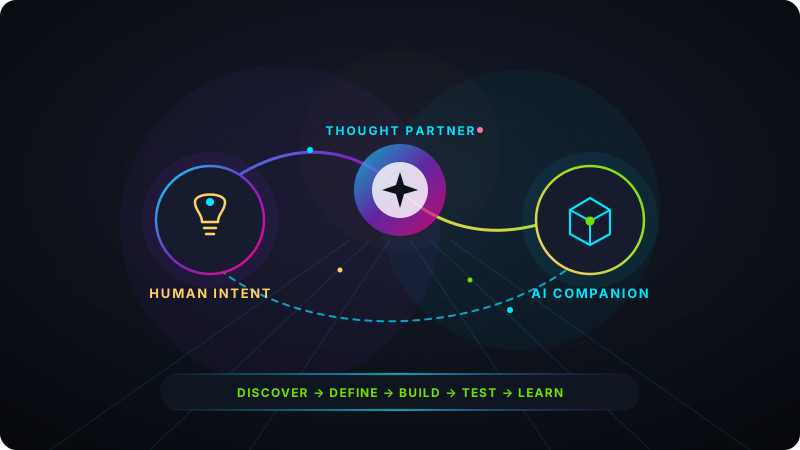
Discover → Define → Build → Test → Release → Learn → Discover againAI can become a companion throughout that loop.
But AI should not become the decision maker
This is where I believe we need to be careful.
A digital companion should support human intelligence, not replace human responsibility.
AI can suggest:
“Here are three possible approaches.”
But we should still decide:
“Which approach makes sense for our customers and our business?”
AI can identify a potential product opportunity.
But the product team needs to understand whether that opportunity is strategically important.
AI can generate code.
But someone needs to review whether that code is secure, maintainable, scalable and appropriate for the product.
AI can summarize customer feedback.
But humans need to understand the context behind that feedback.
The goal should therefore not be:
Human vs AI
It should be:
Human + AI
The importance of context
One of the biggest differences between a simple AI chatbot and a digital companion is context.
A generic AI may know a lot.
But a useful digital companion should understand the context in which we are working.
For example, a product companion could understand:
- Our product roadmap
- Current features
- Customer feedback
- Known issues
- Product priorities
- Technical dependencies
- Previous decisions
- Upcoming releases
With the right permissions and governance, AI can use this context to provide much more relevant assistance.
This is where enterprise AI and AI agents become particularly interesting.
AI Agents can take the next step
A digital companion doesn't have to stop at providing information.
AI agents can potentially take actions based on instructions and permissions.
For example:
“Review the open product issues and identify those that could impact the next release.”
Or:
“Prepare a summary of the high-priority customer issues for tomorrow's product meeting.”
Or:
“Check the project risks and prepare a draft RAID update.”
The important word here is permissions.
An AI agent should only perform actions that it is authorized to perform.
And for important decisions or high-impact actions, human approval should remain part of the process.
My view: AI should amplify our strengths
I don't see AI as a replacement for experience.
In fact, I think experience becomes even more important.
An experienced product owner can challenge an AI-generated recommendation.
A senior developer can recognize when generated code is not appropriate.
A business leader can understand organizational context that may not exist in the available data.
AI can make us faster.
But judgment makes us effective.
That is why I like the term digital companion.
A companion doesn't take over your journey.
It helps you navigate it.
The future is not just AI-powered applications
We are already seeing AI being added to applications.
The next step, in my view, is applications becoming AI-aware and context-aware.
Instead of asking:
“Where do I find this information?”
We may increasingly ask:
“Help me understand this.”
Instead of:
“Which report should I open?”
We may ask:
“What changed this week?”
Instead of:
“Create a task.”
We may say:
“We agreed to address this issue next sprint. Help me capture the required work.”
The interface starts moving from screens and menus toward conversations, intent and actions.
A few principles I would keep in mind
As we bring AI into our products and organizations, I believe a few principles are important:
1. Keep humans in control
AI should support decisions, especially when the impact is significant.
2. Give AI the right context
Better context generally leads to more useful assistance.
3. Start with real problems
Don't introduce AI simply because it is available. Start with a genuine user or business problem.
4. Validate AI output
AI can be extremely useful, but generated content and recommendations still need appropriate review.
5. Build trust
Users need to understand what AI is doing, what information it is using, and when human approval is required.
6. Measure value
AI adoption should not be measured only by the number of AI features. The real question is:
Is AI helping people achieve better outcomes?
From assistant to companion
We have already experienced the first phase of AI: AI as an assistant.
It answers questions.
It generates content.
It writes code.
It summarizes information.
The next phase could be AI as a digital companion.
It understands context.
It remembers the work environment it is allowed to access.
It helps us think.
It identifies what needs attention.
It collaborates with us.
And, when appropriately authorized, it can take action.
For me, the most exciting part of this journey is not the technology itself.
It is the possibility of giving people more time to focus on what humans do best:
Thinking, creating, solving problems, building relationships, and making meaningful decisions.
AI may become our digital companion.
But the person should still be in the driver's seat.