October 7, 2026 | AI Agent | Marketplace | Partner Center | 5 min read
From Development to Marketplace: Bringing AI Agents into the Publishing Workflow
AI agents are changing the way we build software. Today, an agent can help developers write code, understand requirements, test solutions and automate repetitive development tasks.
But what happens after the product is ready?
For many teams, publishing a product to Microsoft Marketplace is still a separate activity involving Partner Center, APIs, schemas, validation and several manual steps.
Microsoft is now bringing Marketplace publishing closer to the development experience with Marketplace Ingestion MCP.
What is Marketplace Ingestion MCP?
Marketplace Ingestion MCP is a Model Context Protocol (MCP) server that connects AI agents and MCP-compatible developer tools with Microsoft Marketplace publishing APIs.
In simple terms, it allows an AI agent to help with Marketplace activities using natural language.
Instead of starting with an API payload, a developer can start with an intention such as:
“Create a SaaS offer for my product and tell me what information is required.”
The agent can then help retrieve the required schema, prepare the information, validate it and create the offer as a draft.
This is an interesting shift:
From “How do I build the API payload?” to “What do I want to publish?”
How does it work?
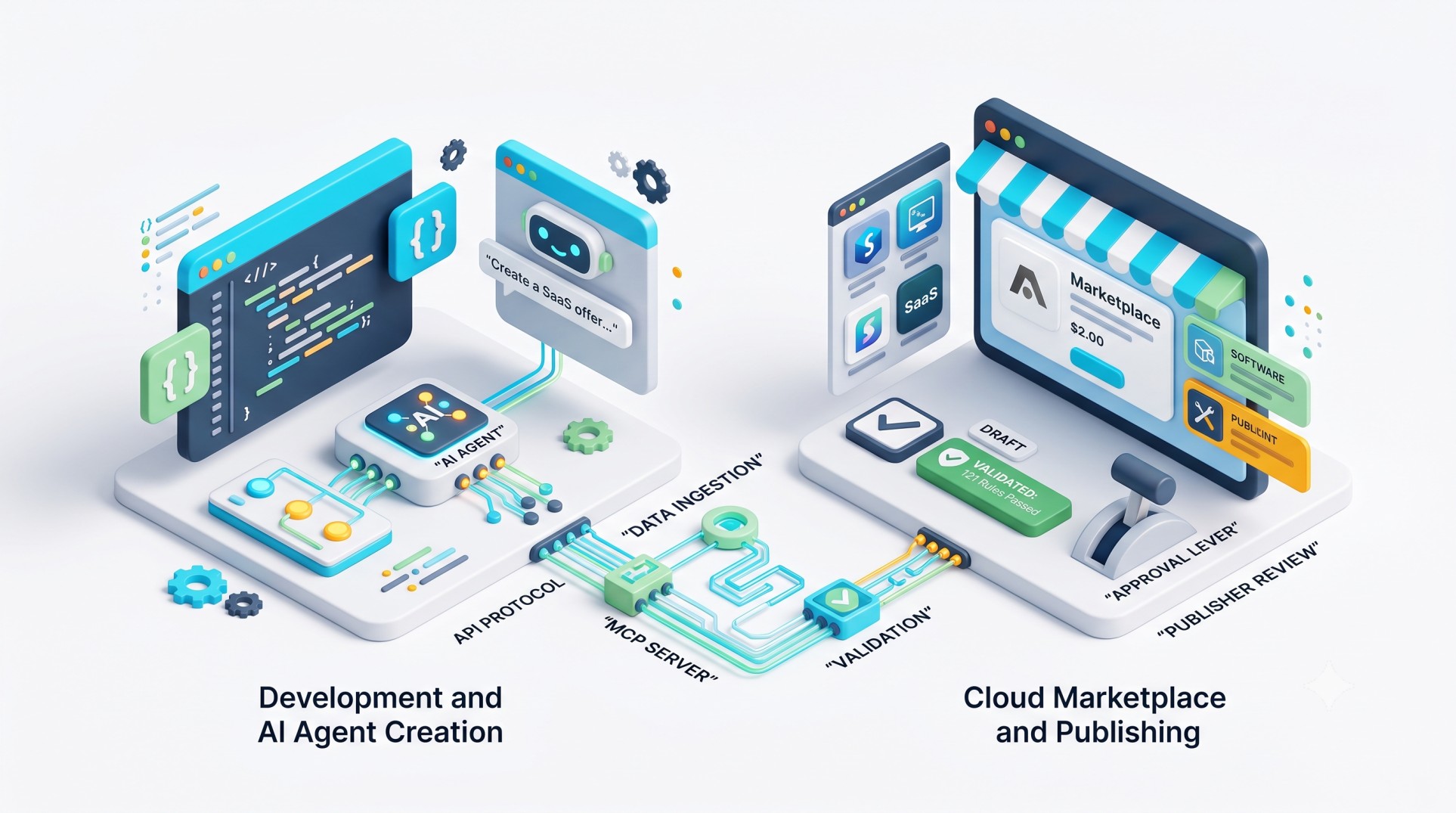
The overall flow can be simple:
Product Development → AI Agent → Marketplace MCP → Validation → Marketplace PublishingFor example:
- A team develops an AI application or SaaS product.
- The developer provides the relevant product information to the AI agent.
- The agent uses Marketplace Ingestion MCP to understand the required Marketplace structure.
- It prepares the required information and validates it.
- The offer can be created as a draft.
- The publisher reviews and approves the required actions.
- Supported publishing activities can then be performed.
The important point is that the publisher remains in control. Approval settings can be used to ensure that important actions are reviewed before they are submitted.
Four areas where this can help
1. Start with intent
Developers don't always need to manually construct API payloads.
They can describe what they want to achieve and the agent can help translate that requirement into the structure expected by Marketplace APIs.
This allows developers to focus more on the product and business outcome rather than the technical details of every API request.
2. Automate repetitive publishing activities
Marketplace publishing can contain repetitive activities, especially when products are updated frequently.
With MCP, teams can explore reusable agentic workflows for activities such as creating offers or updating existing information.
Some of these workflows could potentially become part of a CI/CD process, depending on the organization's publishing and approval requirements.
This makes an interesting connection between:
Development → Testing → Release → Marketplace Publishing
3. Keep humans in the loop
Automation doesn't mean giving complete control to an AI agent.
For Marketplace publishing, human review can remain an important part of the process.
Teams can configure approval settings so that an agent can prepare an action, but a publisher reviews and approves it before the actual change is submitted.
For me, this is an important principle for agentic workflows:
Let AI automate the work, but keep humans responsible for important decisions.
4. Use familiar developer tools
Marketplace publishing can be brought closer to the tools developers already use.
Microsoft highlights support for MCP-compatible clients such as Visual Studio Code and GitHub Copilot CLI.
This means Marketplace activities don't necessarily have to feel like a completely separate process from development.
A simple example
Imagine a company has developed an AI agent and wants to make it available through Microsoft Marketplace.
Today, the team may need to move between development tools, documentation, APIs and Partner Center to prepare the offer.
With Marketplace Ingestion MCP, the team could start with a request such as:
“Prepare a Marketplace offer for this AI agent.”
The agent can then help understand the required information, use the available product details, validate the structure and create a draft.
If the company also wants to monetize the agent, the workflow can be extended to create the required linked SaaS offer.
The goal is not to remove the publishing process.
The goal is to bring publishing closer to the development workflow.
What do you need to get started?
Microsoft currently lists these prerequisites:
- A Partner Center account with the required role
- Access to Microsoft Marketplace publishing APIs
- An MCP-compatible client such as Visual Studio Code or GitHub Copilot CLI
Microsoft also provides documentation covering installation, authentication, available tools, supported products, data handling and an end-to-end SaaS example.
Why I find this interesting
From a product perspective, I see this as more than just another AI capability.
We are moving towards a world where AI agents can participate across the complete product lifecycle.
For example:
Idea → Requirements → Development → Testing → Deployment → Marketplace → CustomerTraditionally, these stages have been handled by different tools and different teams.
Agentic workflows can start connecting these stages together.
Marketplace Ingestion MCP is a good example of this direction. Instead of treating Marketplace publishing as something that happens after development, it can become part of the development and release workflow itself.
Final thoughts
AI agents are increasingly becoming our development companions. The next step is to allow them to work across the broader product lifecycle.
Marketplace Ingestion MCP brings Microsoft Marketplace publishing into that conversation by connecting natural-language intent, AI agents and Marketplace publishing APIs.
The key idea is simple:
Build the product. Describe what you want to publish. Let the agent handle the repetitive work. Keep humans in control of the important decisions.
That combination of AI automation + developer experience + human approval is what makes agentic workflows particularly interesting for the future of software and product development.